

Let’s save you some time and answer the question you actually came here for. A kitchen remodel in Seattle runs anywhere from $30,000 (for a cosmetic refresh) to $150,000+ (for a complete remodel with custom everything). Where you land depends on what decisions you make.
We’ve walked enough people through this room to know that the big question isn’t “What’s the number?” It’s “What am I actually paying for, and is it worth it?”
As a design + build firm in Seattle, we know the commitment involved with a kitchen remodel. Why do we take so much pride in how we do business? Because we do it all. Working with us keeps everything under one roof with one team. If you’re going to pay for a kitchen remodel anyway, it only makes sense to do it with a team who will alleviate the work from you.
How Much To Remodel a Kitchen
As mentioned above, kitchen remodel in Seattle runs anywhere from $30,000 to $150,000+. We mentioned a cosmetic refresh versus a complete remodel with custom everything.
Here’s what we mean:
Cosmetic refresh: Think new paint, refaced cabinet doors and hardware, updated countertops and backsplash tile, and swapped-in lighting fixtures or faucets, all without touching the layout, plumbing, or wiring. These projects tend to land toward the lower end of that range, roughly $30,000 to $60,000 in Seattle, and many don’t require a permit at all.
Complete remodel: Exactly what it sounds like. We’re talking a full teardown and rebuild: reconfiguring the floor plan, relocating plumbing and electrical, adding a kitchen island with its own utilities, and replacing every cabinet, counter, and floor surface from scratch. Because the work touches the home’s structure and systems, projects at this scale almost always require permits from the City of Seattle and land at the higher end of the range, often $100,000 to $150,000 or more for custom finishes.
Now that we’ve established some definitions, let’s get into where your money actually goes. (Note: these are some of the bigger items that take up the budget. Each project is different and requires different needs.)
- Cabinetry eats the biggest chunk of almost every kitchen budget, typically 20 to 25 percent of the total. Stock cabinets keep costs down. Semi-custom gets you better proportions and finish options. Custom is where you pay for exactly the storage and sightlines you want, and it’s usually worth it if you’re doing this once and doing it right.
- Countertops come next, and material choice swings the number fast. Quartz and granite are the workhorses of a kitchen designed for real cooking, handling heat, knives, and daily abuse without having to check on it all the time. Quartz typically runs $50 to $200 per square foot installed for mid-grade material, which lands most kitchens somewhere around $2,500 to $4,500 all-in. Granite tends to come in a bit lower, $35 to $100+ per square foot for most quotes, putting a typical kitchen project in the $2,000 to $6,000 range. Marble looks incredible and photographs better, but it stains, etches, and needs more care than most people expect. It also carries a real price tag, averaging around $40 to $150 per square foot for mid-tier slabs, with kitchen totals landing anywhere from $1,200 to $6,000 depending on grade and finish. Treat these as ballpark figures rather than a quote. Region, slab grade, edge profile, and sink or cooktop cutouts all move the number, sometimes by a lot.
- Labor is the piece people underestimate the most. On a full remodel, labor can run 40 to 60 percent of your total cost, and it climbs fast the second you start to move plumbing, add electrical circuits, or open up walls. A kitchen that keeps its existing footprint stays cheaper. A kitchen that gets an entirely new layout costs more, but it also might finally work the way you actually cook and live.
- Then there’s the fun stuff you don’t see until the walls come down. Old wiring, outdated plumbing, water damage behind a dishwasher that’s been quietly leaking for years. You don’t have to worry with us because we don’t throw any surprises at you. We always build a contingency into the budget before anyone picks a single tile. Your house has been keeping secrets from you for years, and it’s cheaper to plan for those secrets than to get surprised by them in week four. A practical guideline many remodel cost guides recommend is holding roughly 10% to 20% of your total remodel budget as contingency, with higher reserves for older homes, heavy demos, or layout changes.
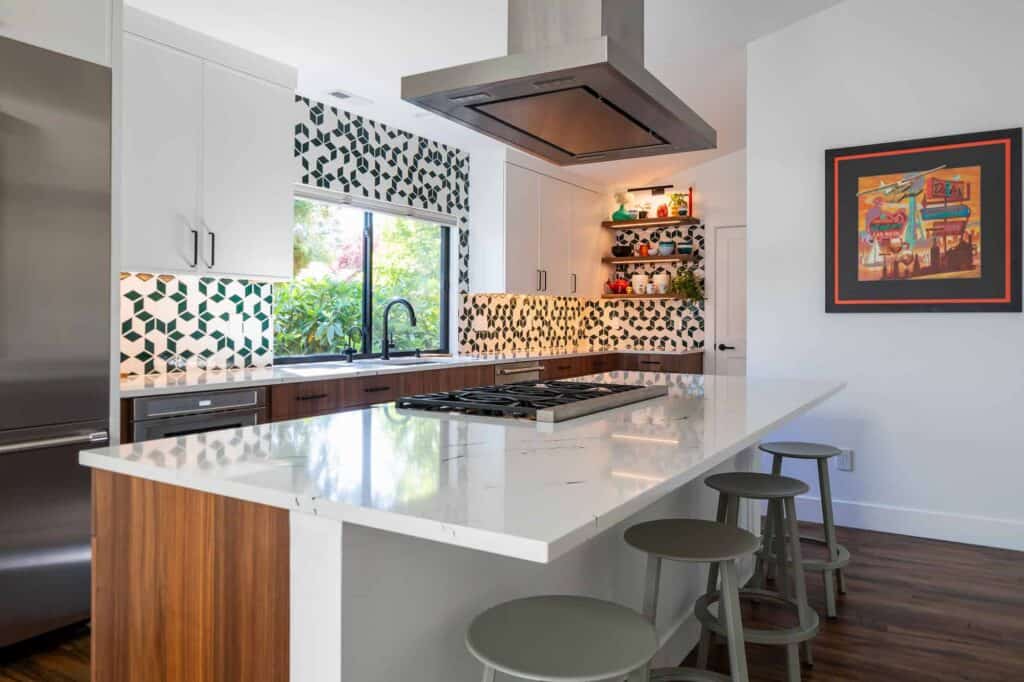
How Long Does A Kitchen Remodel Take
Short answer: longer than you think.
Real answer: 3 to 6 months, with 8-12 weeks of that as active construction.
Planning and design take longer than people expect because good decisions take time. You don’t want to end up rushing your decision time and end up regretting a countertop choice for the next fifteen years. Then after deciding what to do, the materials need to be ordered. Custom cabinets alone can carry an 8 to 16 week lead time depending on the manufacturer, and that clock starts the day you sign off on the design, not the day the demo starts. Countertops need templating after cabinets go in, which adds another one to two weeks before fabrication even begins.
Once construction starts, it moves in a specific order for a reason. Demo, then rough-in plumbing and electrical, then comes the inspections, the drywall, the cabinets, the countertop templating, and finally the finished work that actually makes it look like a kitchen again.
That’s why we start budget and timeline conversations in our very first meeting instead of after the design is chosen and finalized. Knowing the real timeline up front means you can plan your life around it instead of getting blindsided in month two. (Want the full breakdown? Our process page walks through exactly what happens in each stage, budget conversation included.)
Do You Need a Permit To Remodel a Kitchen
Usually, yes. And no, that’s not us being dramatic to justify a line item.
The general rule holds across most cities: cosmetic work like painting cabinets, swapping a faucet, or laying new flooring in the same footprint typically doesn’t need a permit. The second you touch plumbing, electrical, gas lines, or structure, you’re in permit territory.
In Seattle specifically, the city draws the line at minor repairs or alterations under $6,000 in a six month period. Below that, and if you’re not touching load-bearing supports, egress, ventilation, or fire resistance, you may be in the clear. Above it, or the moment a wall, a sink relocation, or a new electrical circuit enters the picture, you need a construction permit and often an electrical or plumbing permit alongside it.
The best part for you? We handle the permitting process for every project we take on.
What This Actually Means For Your Budget
None of these numbers exist in a vacuum. Your cost depends on your timeline, your timeline depends on your scope, and your scope depends on what permits your project triggers. Good news, these are all one conversation, not three separate ones, which is exactly why we handle design and construction under one roof.
A kitchen remodel is one of the biggest checks you’ll write for your house. It deserves a real number, a real timeline, and a real answer on permits before you’re standing in a demoed-out kitchen wondering what happened to your budget.
If you’re ready to find out what your kitchen remodel will actually cost, let’s talk.