
Cabinets are the backbone of your kitchen. They take up the most visual real estate, hold every dish you own, and get touched, opened, and slammed thousands of times a year. They also eat up the biggest chunk of your kitchen remodel budget. (According to HomeAdvisor data, your cabinet costs can range from $100 to $1,200 per linear foot, with a typical 10×10 kitchen totaling between $2,000 to $24,000 installed!)
So when clients tell us they want to “just redo the cabinets,” we get it. But we also know that what looks like a simple swap is actually one of the most consequential design decisions you’ll make in your home. Get the cabinets right and the whole kitchen works. Get them wrong and no countertop, backsplash, or appliance package is going to save you.
Here’s how we think about remodeling kitchen cabinets, the way we’d walk you through it as our client.
How Do You Actually Use Your Kitchen?
Before you pick a single door style, finish, or hardware option, get honest about how you live in this room.
Are you a daily cook or a weekend host? Do you have small kids climbing into low drawers, or empty-nesters who need pull-outs because crouching for a stockpot is no longer the move? Do you bake? Do you have a coffee ritual that deserves its own zone? Is your dishwasher running once a week or twice a day?
We ask these questions (and plenty more!) in our Discovery phase for a reason. The cabinets that work for a family of five who eats at home every night look nothing like the cabinets that work for a couple who orders take-out three nights a week and entertains on weekends. Layout drives everything else, and layout is driven by how you actually live. Not how you wish you lived. Not how Pinterest told you you should live.
Which Cabinet Styles Actually Hold Up?
Cabinet styles cycle harder than you think. The glossy thermofoil cabinets that were everywhere in 2010 are the avocado appliances of this decade. Slab-front cabinets feel current right now, but they’ll feel dated faster than people want to admit. And the all-white shaker that defined the last fifteen years? Already shifting.
Here’s our take. Door style is where you should lean conservative. Raised, Recessed and slab are the three foundations that have endured for decades because they’re rooted in architectural logic, not trend. Within those three, you have miles of room to express personality through types of wood, finish, and hardware.
Then, What Finish for Kitchen Cabinets Is Best?
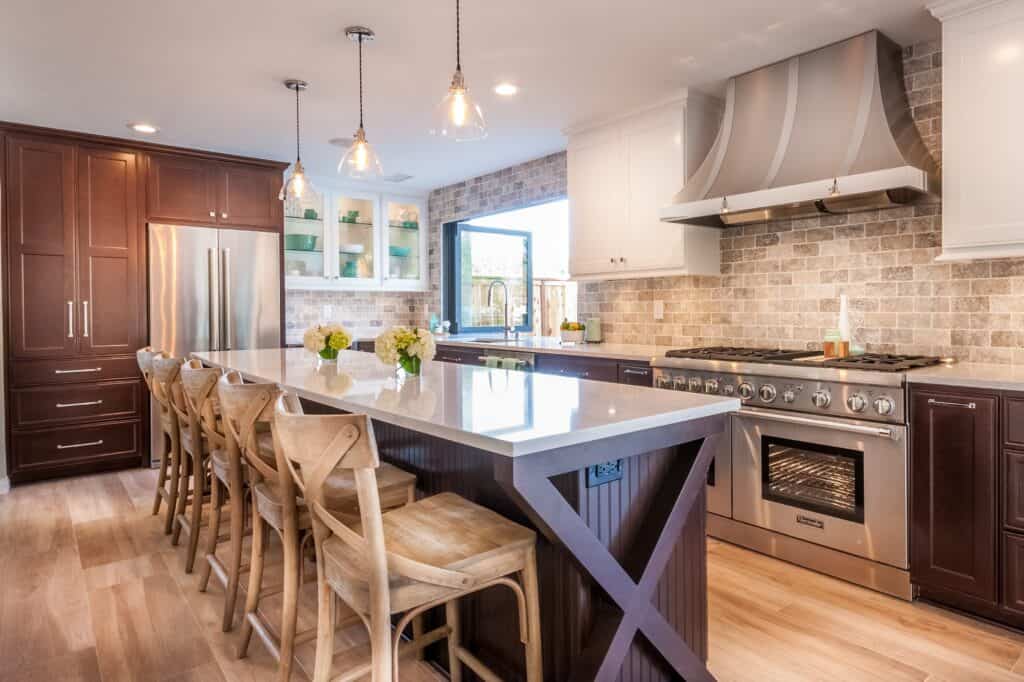
Finish is where a kitchen gets its personality. The finishes we’re specifying in the kitchens we’re designing right now include warm wood tones like walnut, white oak, and rift-sawn, painted cabinets in deep moody colors paired with a lighter island, and integrated handles or minimal hardware that lets the cabinetry speak for itself. They hold up because the materials behave well over time, which is the only kind of finish decision worth making. (For more on the design thinking behind that, our take on mid-century modern principles is worth a read.)
What Paint Finish for Kitchen Cabinets Is Worth Pursuing?
If you’re going painted, the finish you choose matters as much as the color. Our standard spec is satin or low-sheen. It hides fingerprints, wipes clean without buffing, and reflects just enough light to look intentional without going chalky.
What Materials & Construction Should You Actually Care About?
This is where remodeling kitchen cabinets gets technical, and where most homeowners get burned by lowball quotes from other firms. Three things determine whether your cabinets will last more than fifteen years or fall apart in five: box construction, door material, and drawer hardware.
Why Does Box Construction Matter?
Plywood boxes outperform particleboard or MDF. Full stop. They handle moisture, hold screws better, and survive the inevitable leak under your sink that you won’t notice for three weeks.
What About Door Material?
Solid wood doors are beautiful but can move with humidity, which can matter in all Seattle homes. Painted MDF doors are dimensionally stable and take paint well, which is why we spec them often for painted cabinets. Veneered plywood is the sweet spot for wood-look doors.
Where Should You Refuse to Cut Corners?
Drawer hardware. We tell clients this every time. Soft-close, full-extension, undermount drawer slides will outlast the cabinets themselves. Cheap slides are the number one reason people remodel their kitchens twice.
Where Should You Spend, and Where Can You Hold Back?
This is the question that matters most. Every kitchen has a budget ceiling, and the goal isn’t to spread money evenly. It’s to put it where you’ll feel it. (We’ve written more about how to think about a remodel budget here because we know how important this is.)
Spend on the cabinet boxes (you only build them once), the drawer hardware (you touch it every day), and the cabinets that define the room visually (because you look at them every day). These usually include the perimeter run and the island.
Sometimes the smartest move isn’t full custom. Semi-custom from the right manufacturer, with the right designer specifying it, can deliver ninety percent of the result for sixty percent of the cost. The trick is knowing when that’s the right call and when it isn’t. Which is what we’re here for.
Now That We Have All This Info, Here’s the Big Question: When Remodeling a Kitchen, What Comes First?
Cabinets are not step one. We know that’s not what you want to hear when you’ve already picked a color, but the order matters, and starting with cabinets is exactly how kitchens end up working against themselves. It’s the same principle we apply to tile selection across the rest of the home.
Here’s how we sequence it:
- Layout first. Where the sink goes, where the range lives, how the work triangle flows for the way you cook. Every other decision is downstream of this.
- Then the big surfaces. Countertops, flooring, and backsplash get scoped together because the undertone of one shifts how the other reads before anything else gets specified.
- Then cabinets. Now we know what the cabinets have to coordinate with, so door style, wood species, paint color, and hardware can actually belong in this kitchen instead of fighting the stone you just picked.
This is exactly why we love being a one-stop shop. We design and build, so layout, surface selection, cabinet spec, and install all happen with the same team, in the right order, start to finish. If you’re thinking about remodeling your kitchen cabinets and want a team that handles design and build under one roof, let’s talk.
All content on this site is produced in accordance with our editorial standards, including our policies on sourcing, accuracy, and corrections.